


If you live along the Front Range, you know the sound. A warm, dry wind comes over the mountains in the middle of winter, the fence rattles, the trash cans end up in the street, and you spend the night wondering what the roof is doing.
Most people think of hail when they think of roof damage in Colorado. Wind does just as much harm, and it often goes unnoticed because nothing is lying in the yard. Here is what Chinook winds are, how strong they get, and how to tell if one left your roof hurt.
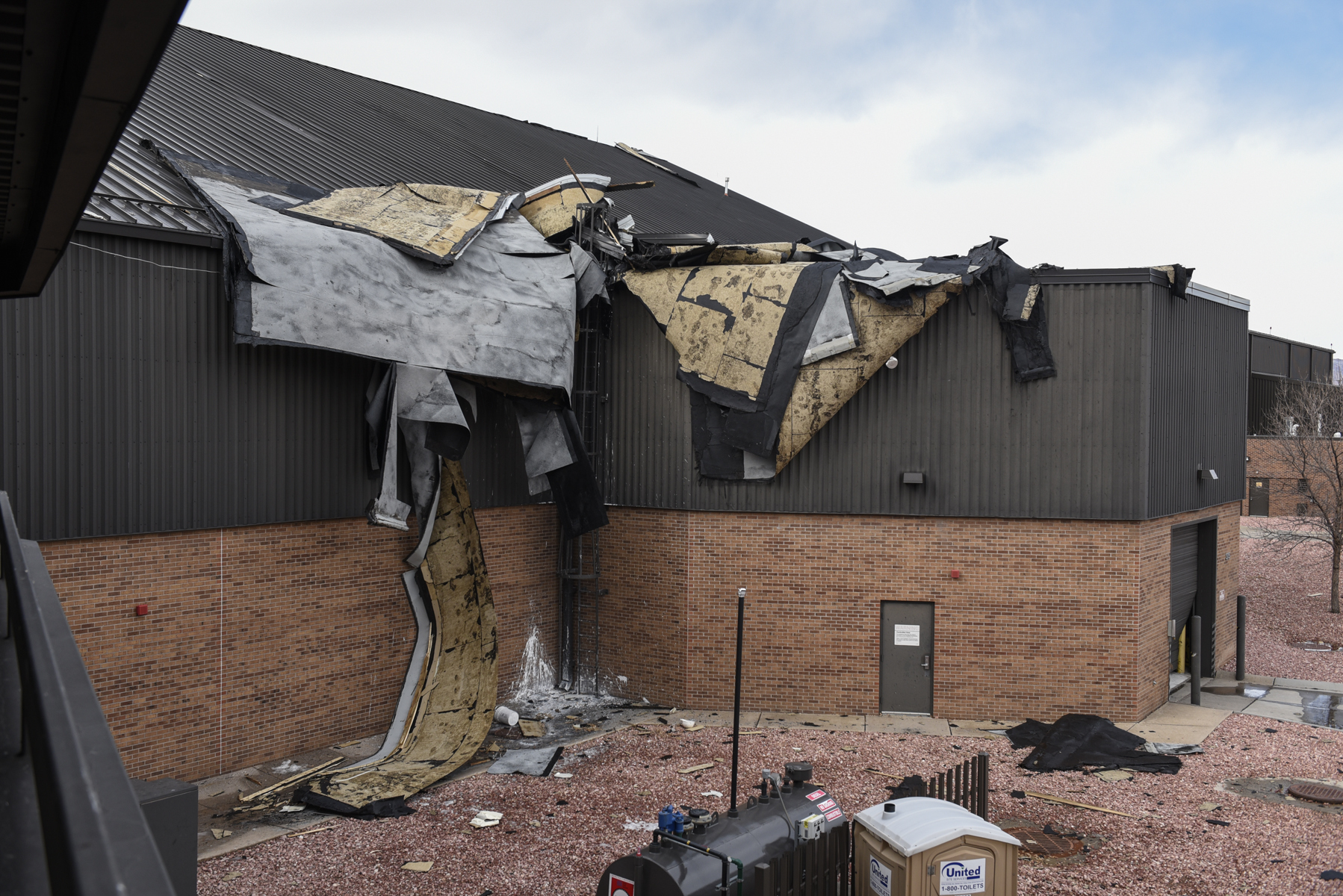
Example of wind damage to a roof (stock photo).
What a Chinook wind is
The National Weather Service describes a Chinook as a warm, dry wind that flows down the east side of the Rocky Mountains. It is common in winter. Air gets pushed over the mountains, drops down the slope, and warms up on the way, so you can see a 50 degree afternoon in January and a lot of wind with it.
You will sometimes see a Chinook arch, a band of cloud over the mountains with a strip of clear sky under it. Locals take it as a sign the wind is coming.
How strong it gets here
The National Weather Service in Boulder says winds of 60 to near 100 mph happen in and near the foothills, in places like Boulder and Denver, and that the Boulder area is especially prone to the extreme ones. In the worst cases Chinook winds can pass 100 mph.
Some context from the weather service on what counts as dangerous:
- A High Wind Warning for the foothills and nearby plains, including Boulder and the western Denver suburbs, means sustained winds of 50 mph for an hour or gusts of 75 mph.
- Lower areas away from the foothills get a warning at sustained 40 mph for an hour or gusts of 58 mph.
The big example is December 30, 2021. A mountain wave windstorm put gusts of 70 to 100 mph at the base of the foothills, and the weather service logged a peak gust of 115 mph near Highway 93 and Highway 72. That is an extreme case, and most windy days are nowhere near it. It does show what these winds can do.
Most Chinook days are much milder. But roofs take a beating from repeated 50 and 60 mph gusts too, because wind works on any edge or seam that is a little loose.
Why wind goes after a roof
Wind does not push down on a roof so much as pull up on it. Air speeds up over the roof and creates lift, a bit like an airplane wing. The edges and corners get the worst of it, which is why damage usually starts at the eaves, the ridge, the rakes and around anything that sticks up.
Once one shingle or one piece of flashing lifts, the wind gets underneath its neighbors, and the damage spreads.
What wind damage looks like
Some of this you can see from the ground. Some you will not see without getting up there.
- Missing shingles. Look for bare patches, or shingles in the yard or the neighbor’s yard.
- Creased or folded shingles. A horizontal crease means the shingle was bent back by wind. It will often tear off the next time.
- Lifted tabs. The shingle is still there but no longer lies flat. The seal strip has let go.
- Loose or bent flashing. Metal around chimneys, vents, skylights and walls can peel back. These are the spots that leak first.
- Ridge cap damage. The cap shingles along the peak are exposed and take a lot of wind.
- Drip edge or fascia pulled loose. If the metal along the edge is bent or sticking out, wind can get under the roof.
- Flat roof membrane lifting. On flat roofs, look for edges that have curled up, seams that opened, or bubbles and ripples.
- Tree limbs and fence boards on the roof. Even if nothing broke, an impact can crack a shingle or dent metal.
A leak is the late sign. A roof can have wind damage for weeks before a stain shows up on the ceiling.
What to do after a windy night
- Look from the ground first. Walk around the house with binoculars if you have them. Please do not climb up in the wind or onto a wet or icy roof.
- Take photos. Photograph anything you see, with the date. Shingles in the yard count. This helps if you file an insurance claim.
- Check the attic. Look for daylight, damp insulation or water stains near the roof edges and around chimneys and vents.
- Cover only what you have to. If a section is open and weather is coming, a tarp is a short-term fix. Keep it simple and do not take risks to put it up.
- Get it inspected. A roofer can see things from the roof that you cannot from the ground, and can tell you if it is a small repair or something bigger.
Repair or replace?
Most wind damage is a repair. A handful of missing shingles, a bent piece of flashing or a lifted ridge cap can be fixed without touching the rest of the roof. That is the honest answer, and we will tell you if that is what we see.
Replacement makes sense when damage is spread across a slope, when the shingles are old and brittle and will not seal back down, or when the same roof has been patched again and again.
One thing worth knowing: shingles are tested for wind resistance, and in a place like Broomfield, which has a 110 mph design wind speed, building code calls for shingles tested to a set standard (ASTM D3161 Class F, or ASTM D7158 Class G or H). A good install matters just as much as the rating, since a shingle only holds if it is nailed right and the seal strip is stuck down. An older roof that has lost its seal will not perform like the label says.
Wind damage and insurance
Wind is usually covered under a standard homeowners policy, but deductibles and rules vary. Read your policy and call your agent. Do not wait on it, because most policies have a time limit for filing. We can look at the roof, take photos and give you a written description of what we find to hand to your insurance company. We do not give legal or coverage advice.
Where we work
Rize Exterior Services is a family-run roofing company with offices in Lakewood and Denver. We cover the west metro and the Front Range, including Golden, Arvada, Wheat Ridge, Westminster, Thornton and Centennial. If the wind has you worried, see our wind damage roof repair page or roofing inspection page, or call us at (303) 284-5947 (Lakewood) or (720) 512-3465 (Denver). If water is already coming in, it is an emergency roof repair call and we will get someone out.
Frequently asked questions
What is a Chinook wind?
A Chinook is a warm, dry wind that blows down the east side of the Rocky Mountains. It is most common in winter, and it can produce very strong, gusty winds along the Front Range.
How strong do Chinook winds get in Denver and Boulder?
The National Weather Service in Boulder says winds of 60 to near 100 mph can occur in and near the foothills, including Boulder and Denver. The strongest events can pass 100 mph.
How do I know if wind damaged my roof?
Look for missing, creased or lifted shingles, bent flashing, damaged ridge caps and loose metal along the edges. Check the attic for daylight or water stains. A leak is often the last sign, so a roof can be damaged well before it drips.
Does homeowners insurance cover wind damage to a roof?
Usually yes, but it depends on your policy and deductible, and there is a time limit for filing. Call your insurance agent. We can inspect the roof and document what we find.
Can wind damage be repaired, or does the whole roof need replacing?
Often it is a repair. Replacement is for damage spread over large areas, brittle older shingles that will not reseal, or a roof that has failed repeatedly.
